



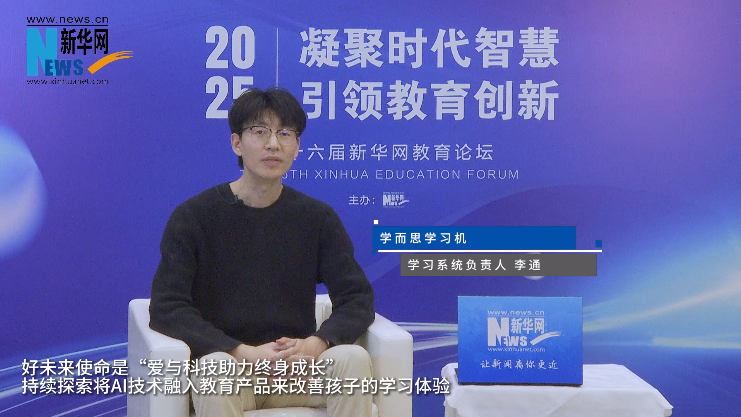
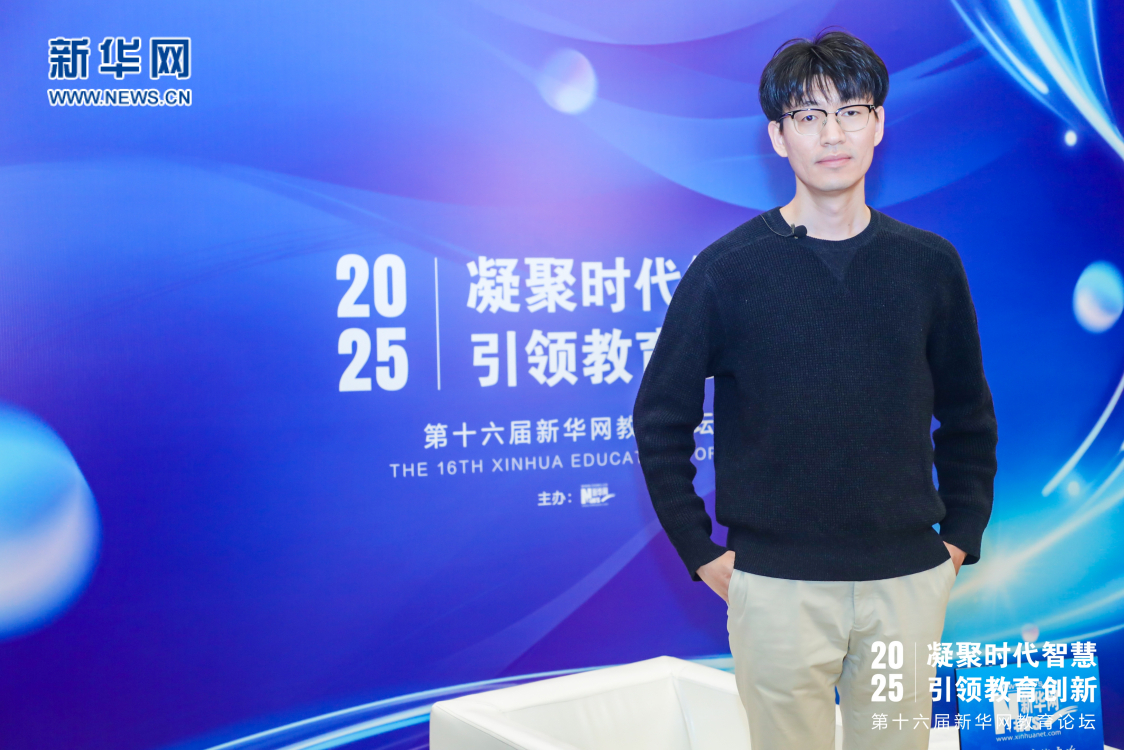
Recently, the 16th Xinhuanet Education Forum, themed "Harnessing the Wisdom of the Era to Lead Educational Innovation," took place in Beijing. In the same event, Li Tong, Head of the Learning System at Xueersi Smart Learning Devices Tablet, shared insights and practices regarding the integration of AI and education in an exclusive interview.
Q1: Generative AI is profoundly impacting the education field. What are your company’s plans and strategies in this area?
TAL is an education technology company, and our mission is "To empower life-long growth with love and technology." For a long time, we have been exploring ways to integrate AI technologies into educational products to improve children’s learning experiences. Since the rise of large models, we have been at the forefront of self-developing dedicated educational large models, becoming one of the first education companies in China to obtain model registration. Our MathGPT large model has delivered outstanding results in key educational scenarios, such as explaining, solving, and grading questions.
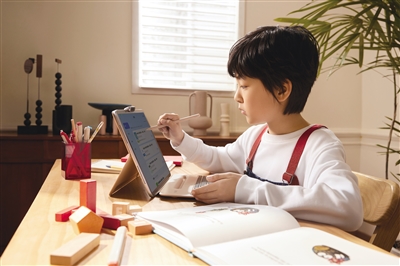
On the product side, we are actively promoting the application of large model technology in real-world teaching services, with the learning device business being a typical example. We are working to effectively integrate more than 20 years of on-the-ground teaching experience and methods of TAL's frontline educators into the large model’s capabilities, while combining it with child-specific learning hardware to create an integrated intelligent learning experience of “Content x AI x Software & Hardware.” We have already made significant progress in this regard. Beyond home-learning scenarios, we are also working on deploying learning devices in school classrooms and offline training institutions, while positioning them as standard equipment for online education.
Through these strategic layouts, we hope to better support the intelligent growth of the next generation of children using the “Content x AI x Software & Hardware” model.
Q2: In advancing digitalization in education, what do you think are the main challenges in the industry today? Does your company have targeted solutions to address these issues?
It is often said that there is an "impossible triangle" in the education industry, where quality, scale, and personalization cannot all be achieved simultaneously. For instance, combining scale and quality is exemplified by online large-class education, while combining quality and personalization often involves one-on-one tutoring. However, combining scale with personalization has been a significant challenge historically. The advent of large model technology offers a new possibility to address this challenge.
From the perspective of the education industry as a whole, there are still many practical challenges in applying large models to real teaching practices. Among them, the most prominent is at the conceptual level: there are differing views on whether and how to introduce large models into education. Facilitating broader societal acceptance of new technologies and models will itself be an area requiring gradual breakthroughs.
Secondly, the introduction of large models into educational settings is not merely a simple application of a technology—it also triggers structural changes in the way teachers work and students learn. Fundamentally, this represents a "reconstruction of production relationships" surrounding new technologies. Achieving efficient human-AI collaboration and genuinely improving teaching efficiency will require continued exploration and practice.
Q3: AI is reshaping social structures. What do you think is its most significant impact on education, and how should we leverage it to adjust the relationship between ‘teaching’ and ‘learning’?
I believe there are two core impacts:
Firstly, the scarcity of knowledge and the pathways of immediate knowledge transfer are undergoing change. Traditional education places significant emphasis on the memorization and mastery of knowledge. However, with the continued advancement of new technologies, it is conceivable that in the future, every child could have access to a large model as a knowledge assistant. The emphasis on rote memorization and learning for knowledge retention might progressively decrease in education. Instead, the focus will shift towards developing students' abilities to apply knowledge to address real-world issues, along with fostering critical character traits, curiosity, and comprehensive abilities. Thus, the way knowledge is acquired is transitioning from scarcity to abundance, and the pathways of knowledge transfer are evolving from centralized approaches to diversified methods, fundamentally transforming teacher-student dynamics in this process.
Secondly, large models essentially represent a transformative change in productivity. The education industry, marked by imbalanced supply-demand dynamics, stands to benefit significantly from this transformation. We believe these models will unlock unprecedented opportunities to achieve scalable, personalized teaching, ultimately fulfilling the ideal of “education tailored to individual needs.”
Looking into the future, the overall trend in teaching relationships will evolve toward a collaborative approach, where teachers and students work together in a guided partnership with AI. Specifically, the teacher’s role will shift from solely imparting knowledge to inspiring, guiding, and exploring alongside students. Classroom teaching will integrate more real-world project exploration and case-based learning, guiding students in solving authentic issues.
As this process unfolds, both teachers and students will gradually learn to collaborate effectively with AI and become proficient in human-AI teamwork. In doing so, technology will help free educators and learners from repetitive and mechanical tasks, enabling them to focus more on igniting curiosity, nurturing good habits, and addressing the essence of education—real-world problem-solving. This transformative change might be one of the most exciting and anticipated shifts in the future landscape of education.
Source:
Xinhuanet
https://education.news.cn/20251218/8c94314c62004d87ad456e91930295d9/c.html

 1405
1405