




2025 is regarded as a key milestone for the comprehensive implementation of the "AI+" initiative, as artificial intelligence penetrates every aspect of education at an unprecedented pace, with new application models and teaching tools emerging almost daily.
Returning to an educational perspective, one core question urgently needs to be answered: when the demand for "AI+ education" is ignited, which products can truly resolve the profound challenges present in traditional education?
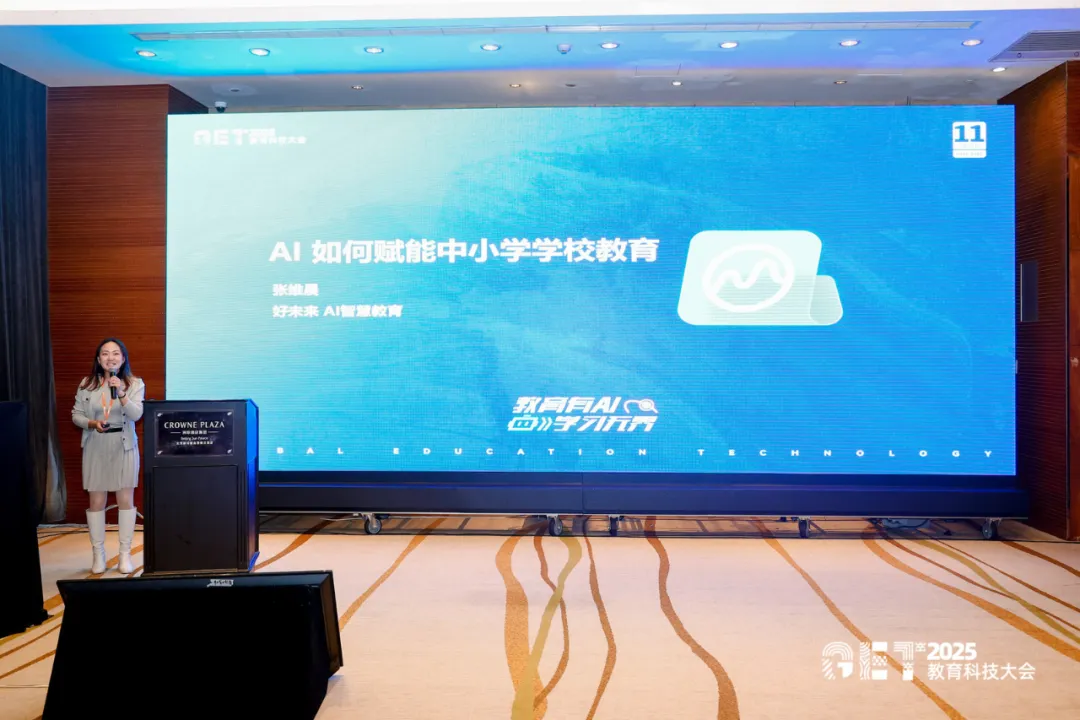
TAL AI Smart Education Product Director Zhang Weichen
Delivered a keynote speech titled "How AI Empowers K-12 Education",
As TAL AI Smart Education Product Director Zhang Weichen pointed out in his speech at the GET2025 EdTech Conference: "The value of AI in educational scenarios lies in addressing the real pain points faced by schools, becoming practical tools that support teaching and assist students’ development."
For a long time, the standardized approach of traditional education has created challenges for teachers, students, and parents in educational practice.
"Every student has a teaching method that best suits them, but the reality is that time and energy don't allow it," a frontline teacher admitted. On the teacher side, limited resources and heavy workloads stand out as critical issues. Especially in public schools, where class sizes are typically large, teachers have to juggle multiple tasks. Routine works like grading assignments and preparing lessons consume a large portion of their time. New teachers, lacking hands-on teaching experience and facing prolonged training periods, often have to dedicate extra hours to meet the teaching requirements.
This constrained teacher capacity directly impacts students’ learning experiences. Without targeted knowledge reinforcement or personalized tutoring after class, students often face situations where "they attend class yet fail to complete assignments." The lack of transparent learning outcomes and delayed feedback leads many students to struggle with anxiety under academic stress. What's more, the education system often lacks personalized care or support for students’ mental health.
Simultaneously, parents are frequently left in the dark ("information black box"), dealing with high communication costs with schools and struggling to keep up with their children's learning progress in real-time. At the school level, precise learning diagnostics for individual students remain challenging.
Small-class teaching, though an ideal solution, proves to be prohibitively expensive and resource-intensive, making nationwide implementation difficult.
With policies like the "Double Reduction" initiative directing education back to its essence and reducing burdens on students, the urgent need for upgrading the educational supply structure becomes increasingly pronounced. Faced with these challenges, "AI+ education" has transitioned from a technological concept to an imminent demand in reality.
Currently, China is witnessing collaborative efforts from policymakers, schools, and enterprises to push deeper integration of AI into education.
In a recent policy document, "The Opinions on Thoroughly Implementing the 'Artificial Intelligence+' Initiative", released by the State Council, it was explicitly stated: "Integrate artificial intelligence into all aspects and stages of education." Likewise, the Ministry of Education issued follow-up policies, such as "Opinions on Enhancing the Reform of the Secondary and Primary School Teacher Workforce", and "Measures to Further Reduce Non-Teaching Burdens for Middle and Primary School Teachers," emphasizing reducing the workload on school teachers via innovative technologies like artificial intelligence.
However, despite the accelerated emergence of AI educational products, the alignment between technology and teaching scenarios isn't guaranteed. A provincial survey indicated that only 35% of teachers could proficiently use intelligent teaching tools. Zhang Weichen suggests, "Policy support has been key, but school-entering products cannot rely on technology alone. If unable to embed seamlessly into teaching contexts and meet the genuine demands of schools, they are destined to be 'shelved'."
In line with national policy guidelines and on-the-ground teaching pain points, TAL has dissected the role of AI in education more deeply. "By closely analyzing the teaching scenarios of secondary and primary schools in public settings and conducting extensive interviews with teachers, students, and parents, we identified two critical value points of AI in education: empowering teachers to reduce workloads and increase efficiency, and helping students achieve personalized learning. With the support of AI large models, these ambitions for quality and efficiency enhancements are finally becoming a reality," Zhang Weichen complemented.
Embracing the convergence of new technologies with educational demands, TAL has introduced its AI Smart Education system "MathGPT AI Learning", designed as an efficient learning and teaching tool in the AI-driven era.
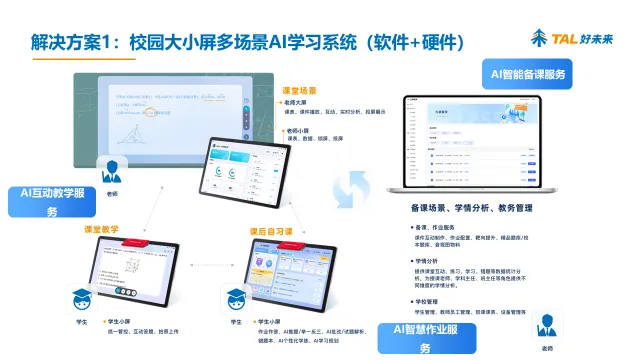
The "MathGPT AI Learning" system, built upon TAL’s proprietary MathGPT framework along with versatile open-source models like DeepSeek, presents a multi-scenario smart education solution for campuses. It delivers a complete AI application loop spanning pre-class preparations, in-class teaching, and post-class learning, shaping an all-encompassing "AI+ education" intelligent ecosystem.
Many frontline educators have shared that prior AI tools faced issues like complexity, high learning costs, and poor adaptability to real-world teaching. Tailored to first-hand teaching requirements in China’s secondary and primary schools, "MathGPT AI Learning" acts as an intelligent assistant for teachers. It covers a wide array of functions, including preparation of teaching materials, test design, and the creation of innovative lesson plans, bridging gaps in the application of AI large models for educators. For instance, in lesson preparation, MathGPT achieves seamless AI collaboration via interactive, form-based, and template-driven designs, enabling teachers to generate lesson plans with minimal inputs, significantly improving preparation efficiency.
In classrooms, MathGPT enables dual-screened interactive teaching, allowing teachers to use large displays and students to interact through tablets, crafting a two-way collaborative smart classroom. This enhances teaching interactivity, enabling educators to monitor students’ learning progress instantly and adjust lessons accordingly.
On the student end, MathGPT’s mobile app delivers personalized tutoring solutions post-class. By tracking students' real-time progress and leveraging automated grading, error summarization, knowledge weak-point detection, and tailored practice questions, the system ensures genuinely "customized homework." Additionally, it auto-generates student-centric progress reports, offering scientific learning analyses for parents while supplying teachers with precise instructional feedback.
Notably, MathGPT distinguishes itself in intelligent Q&A assistance with its “Socratic-questioning method,” promoting guided discovery rather than "photo-to-answer convenience." By engaging students in critical reasoning, its design encourages skills like expression, analysis, and independent thought.
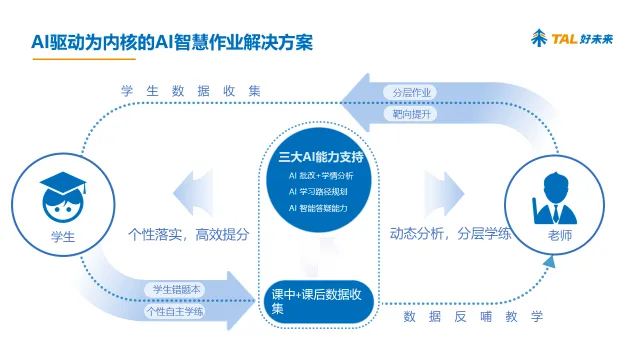
Since its launch, "MathGPT AI Learning" has been piloted in cities like Beijing, Shanghai, Jiangsu, Zhejiang, and Guangzhou, with dozens of trial schools and partnerships across over 100 institutions nationwide. It has been integrated with national platforms, including the National Smart Education Open Platform and various provincial and municipal public education platforms.
AI is subtly transforming the teaching and learning experiences within schools. "With AI’s help, I now have more time to focus on what truly matters to me as an educator," remarked a Chinese language teacher from Chengdu. From her perspective, the most valuable aspect of AI is its ability to grant time for observing individual students and reflecting on her teaching approaches.
Students resonate similarly. "I like knowing immediately where I went wrong after homework because by the next day, I may forget my original thinking process," shared a middle schooler.
Whether teachers or students, most recognize AI's irreplaceable value as an "educational assistant." Their expectations signal the importance of grounding AI education products in authentic teaching contexts. Just as Zhang Weichen emphasized in his speech: "We firmly believe that in classrooms, teachers must remain dominant, while we focus on delivering tools and support."
As AI technology continues integrating into educational contexts, future education will prioritize personalization and intelligence. At the intersection of technological strength and educational philosophy, TAL pioneers a transformative journey in smart education. This path challenges perseverance, requiring both substantial investments and consistent efforts. However, it presents a tangible, practicable solution for the intelligent evolution of education. TAL, committed to continuous exploration, aims to bring smart education into every real-world school.

 3901
3901